Product Description Writing That Sells: AI + Human Hybrid Approach (With Templates)

Writing product descriptions is one of the most time-consuming tasks in e-commerce — and one of the most impactful. A compelling description can increase conversion rates by 30-50%, while a generic one blends into the noise. The solution? A hybrid approach that uses AI for speed and human editors for persuasion, accuracy, and brand voice. This guide gives you the exact workflow, complete with templates you can start using today.
01Why Product Descriptions Matter More Than You Think
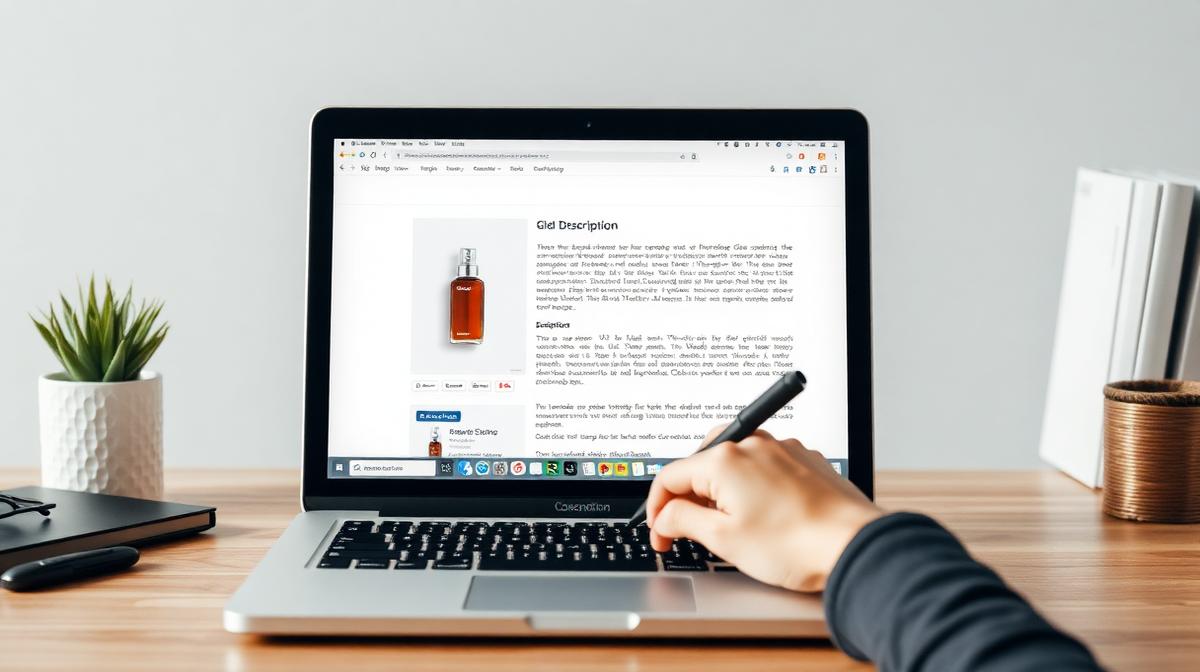
Product descriptions are your silent salespeople. They work 24/7, answering questions and overcoming objections. Here's the data:
| Factor | Impact of Good Descriptions | Impact of Poor Descriptions |
|---|---|---|
| Conversion rate | +30-50% increase | –20% decrease (vs. well-written) |
| Return rate | –15-25% fewer returns | Higher returns due to mismatched expectations |
| SEO ranking | Top 10 for long-tail keywords | Invisible to search engines |
| Customer trust | Professional, credible brand | Cheap, untrustworthy perception |
| Time on page | 3-5 minutes average | Under 30 seconds (bounce) |
The Problem with Pure AI-Generated Descriptions
AI tools can generate product descriptions in seconds, but they have significant limitations:
- Generic tone: AI descriptions sound alike — your competitors using the same tools produce nearly identical copy.
- Factual errors: AI may hallucinate features, materials, or specifications that don't exist.
- Missing brand voice: AI can mimic but not embody your brand's unique personality and values.
- SEO over-optimization: AI tends to keyword-stuff, creating descriptions that read like robots wrote them (because they did).
- No customer empathy: AI doesn't understand your customer's fears, desires, and decision-making process the way a human does.
02The AI + Human Hybrid Workflow

The hybrid approach gives you the best of both worlds: AI speed with human quality. Here's the step-by-step process:
Step 1: AI Draft (2 minutes per product)
- Feed the AI your product specifications: name, category, materials, dimensions, features, and target audience.
- Use a structured prompt that includes your brand voice guidelines, target keywords, and desired word count.
- Generate 2-3 variations and select the best starting point.
- Don't expect perfection — this is a rough draft, not the final copy.
AI Prompt Template
Use this template for consistent AI-generated drafts:
"Write a [word count]-word product description for [product name]. Category: [category]. Materials: [materials]. Key features: [list]. Target audience: [audience]. Tone: [brand voice]. Include: benefits over features, a compelling hook, and a clear call to action. Target keyword: [keyword]. Format with bullet points for features and a paragraph for the story."
Step 2: Human Editing (5-8 minutes per product)
This is where the magic happens. A skilled editor transforms the AI draft by:
- Verifying accuracy: Cross-check every specification, material claim, and feature against actual product data.
- Injecting brand voice: Rewrite key phrases to match your brand's personality — playful, luxury, technical, eco-conscious, etc.
- Adding customer empathy: "You know that frustrating moment when..." — connect with the problem your product solves.
- Improving SEO naturally: Weave in target keywords and related terms without disrupting readability.
- Creating urgency: Add scarcity, social proof, or time-sensitive elements where appropriate.
- Formatting for scanners: Bold key benefits, use bullet points, and break up text with subheadings.
Step 3: Platform Optimization (2-3 minutes per product)
Adapt the final description for each selling platform:
| Platform | Ideal Length | Format | Key Requirements |
|---|---|---|---|
| Shopify | 150-300 words | HTML with bullets | SEO meta title + description, alt text |
| Amazon | 200+ words + 5 bullets | Plain text bullets + A+ content | Keyword-rich title (200 chars), backend search terms |
| Etsy | 200-500 words | Plain text paragraphs | First 160 chars critical for search, 13 tags |
| WooCommerce | 150-300 words | HTML with rich formatting | Short description + long description, schema markup |
| eBay | 200-400 words | HTML with images | Item specifics, mobile-responsive HTML |
03Templates That Convert
Template 1: The Problem-Solution Format
"Tired of [common problem]? Our [product name] [solves it by doing X]. Made from [premium material], this [product type] features [key benefit 1], [key benefit 2], and [key benefit 3]. Unlike [competitor/generic alternatives], ours [unique differentiator]. [Social proof sentence]. [CTA]."
Template 2: The Story Format
"We designed [product name] for [specific person/scenario]. When [relatable situation], you need [product benefit]. Crafted from [material] and tested by [authority/process], every detail — from [feature 1] to [feature 2] — is built to [primary benefit]. [Sensory/emotional detail]. [CTA]."
Template 3: The Feature-Benefit Hybrid
[Opening hook — emotional or problem-based]. Key Features: • [Feature] → [Benefit for customer]. • [Feature] → [Benefit for customer]. • [Feature] → [Benefit for customer]. Specifications: [Material, Dimensions, Weight, Care]. [Trust signal]. [CTA]."
04SEO Optimization for Product Descriptions
- Primary keyword in first sentence: Natural integration, not forced. "This organic cotton baby onesie..." rather than "Organic cotton baby onesie for sale online buy now."
- LSI keywords throughout: Related terms that signal topic relevance — "soft fabric," "newborn clothing," "GOTS certified," "nursery essentials."
- Unique content per product: Never duplicate descriptions across similar products. Google penalizes duplicate content.
- Schema markup: Add Product schema with price, availability, reviews, and brand for rich snippet eligibility.
- Alt text on images: Descriptive, keyword-rich alt text on every product image.
05Scaling Product Descriptions
For stores with hundreds or thousands of products, the hybrid approach scales efficiently:
- 10-50 products: Write individually with the hybrid workflow. 7-13 minutes per product = 1-2 full days.
- 50-500 products: Create category-specific templates and batch process with AI + human QA. Use a spreadsheet workflow.
- 500+ products: Partner with a specialized agency like InfiniCore DataWorks. We handle the entire pipeline — AI drafting, human editing, platform formatting, and SEO optimization — at scale.
06Recommended Resources & Tools
- Google Product Schema Documentation — Official guide for adding Product structured data to your product pages for rich snippets.
- Amazon Product Detail Page Rules — Amazon's official guidelines for product titles, descriptions, and bullet points.
- Nex-Automata Digital Agency — Our sister agency offering AI-powered content creation and e-commerce copywriting services.
- Flora Medical Global — Our ecosystem partner for medical product documentation and regulatory-compliant descriptions.
How Much Do Product Descriptions Cost?
DIY with AI hybrid: USD 0.50-2.00 per product (your time + AI tool cost). Professional copywriter: USD 25-100 per product. Agency service like InfiniCore: USD 3-8 per product at volume (including AI draft, human editing, SEO, and platform formatting).
Can AI Replace Human Product Copywriters?
Not yet. AI is excellent at generating first drafts and handling repetitive variations, but human editors are essential for accuracy verification, brand voice consistency, emotional connection, and strategic positioning. The hybrid approach outperforms both pure AI and pure human writing.
How Long Should a Product Description Be?
150-300 words for standard e-commerce products. 300-500 words for complex or high-ticket items. 50-100 words for simple commodity products. The key is completeness — cover all the information a buyer needs to make a confident purchase decision, nothing more.

Md Jamrul Mia
Founder, InfiniCore DataWorks · Senior E-commerce & Data Specialist
10+ years of freelancing experience and 500+ projects delivered for clients across the US, UK, Canada, Australia & Europe. Top Rated on Upwork (4.9★) and 5.0 on Fiverr — specializing in data entry, web scraping, e-commerce operations, AI automation, and web development.
Comments (0)
No comments yet — be the first to share your thoughts.
Leave a Comment
Automated Order Tracking Emails for Shopify and WooCommerce: Setup Guide
Ethical Web Scraping for B2B Lead Generation: The Complete Guide
Related Articles

VA SOP Library for E-Commerce Operations
A ready-to-use library of Standard Operating Procedures (SOPs) for virtual assistants managing e-commerce stores.

Shopify vs WooCommerce in 2026: Honest Comparison for US, UK, CA, AU & EU
Choosing between Shopify and WooCommerce? This data-driven comparison covers pricing, features, scalability, SEO, and market fit across five regions — so you can pick the right platform for your business.